Re-Entry Permits and Multiple Entry
If you leave Thailand on the wrong visa or stay type without a re-entry permit, you can lose your entire current permission to stay.
Quick video guide
Watch the difference between re-entry permits and multiple-entry visas
This short video gives a fast explanation of the rule that catches people out most often: if your stay inside Thailand is not already protected by built-in multiple entry, leaving without the correct re-entry permission can cancel it.
- Understand the difference between a multiple-entry visa and a multiple re-entry permit before you travel.
- See why retirement, marriage, work, and other in-country extensions are the situations where people most often make costly mistakes.
- Get the core rule in under a minute, then use the details below if you want the full explanation.
We only add ฿200 on top of the official immigration fee.
Thailand immigration rules can be confusing because people often mix together three different things: a visa, an extension of stay, and a re-entry permit. They are not the same. A re-entry permit does not create a new visa, does not extend your permitted stay, and does not replace a multiple-entry visa. It only protects your current permission to stay when you leave Thailand and come back.
Single re-entry permit
Protects one departure and one return on your current permission to stay.
Multiple re-entry permit
Allows unlimited departures and returns for the remaining validity of your current permission to stay.
Airport option
A re-entry permit can often be arranged at the airport on the date of departure, but you should never rely on that as your only plan if your trip is important.
Most common mistake
Assuming your visa extension, your visa sticker, or your previous travel history automatically means you can leave and come back without applying first.
What a re-entry permit actually does
If you are currently permitted to stay in Thailand and your stay is not already covered by a built-in multiple-entry visa, leaving Thailand without a re-entry permit normally ends that current permission to stay. That is the key rule. Many people think the visa in the passport remains untouched no matter what, but in many common long-stay situations that is not how it works.
A re-entry permit is therefore protective. It tells immigration that when you leave the country, you intend to return and continue using the same permission to stay for whatever time remains on it.
Important distinction
A re-entry permit is not a visa, not a visa extension, and not a shortcut around immigration requirements. It only preserves the permission you already have.
Single re-entry permit vs multiple re-entry permit
A single re-entry permit is for one trip. You leave Thailand once, you return once, and that permit is finished. If you leave again later, you need another one unless you buy a multiple re-entry permit instead.
A multiple re-entry permit is often the better choice for people who expect to travel more than once. It allows unlimited re-entries during the remaining validity of your current stay. If you have a retirement extension, marriage extension, business extension, or another long stay and you travel more than occasionally, the multiple re-entry permit is usually the safer and less stressful option.
How multiple-entry visas are different
A multiple-entry visa already contains repeated entry rights inside the visa itself. That means the permission to leave and re-enter is built into that visa category for its validity period. In those cases, you normally do not buy a separate re-entry permit because your visa already provides the multiple-entry feature.
This is where a lot of confusion begins. People hear the phrase "multiple entry" and assume it always refers to a visa. In practice, Thailand uses the term in two different ways: first, a multiple-entry visa issued with entry rights already included; second, a multiple re-entry permit purchased to protect a different stay type that is otherwise single-entry.
Visa types that generally do not need a separate re-entry permit because multiple entry is already included
The safest rule is simple: if your visa was issued as multiple entry by design, and it is still within that validity, you generally do not need to buy a separate re-entry permit. Common examples include the following:
Destination Thailand Visa (DTV)
The DTV is designed as a multiple-entry visa, so you normally do not need a separate re-entry permit while your DTV remains valid.
Multiple Entry Tourist Visa (METV)
The METV already allows repeated entries during its validity period, so a separate re-entry permit is generally not required for that visa.
Long-Term Resident (LTR) visa
LTR visas are issued for long-term residence with multiple entry included, so they are generally outside the normal re-entry permit problem.
SMART Visa
SMART Visa holders are normally granted multiple entry as part of the visa itself, so a separate re-entry permit is usually unnecessary.
Thailand Privilege / Elite visa
Thailand Privilege visas are built for repeated travel and do not normally rely on a separate TM.8 re-entry permit.
Embassy-issued multiple-entry Non-Immigrant visas
Some Non-Immigrant visas issued outside Thailand are stamped as multiple entry. If your visa sticker itself clearly says multiple entry, that entry permission is already built in for that visa validity.
Important caution about extensions
Even if your original visa once had multiple-entry features, that does not automatically mean every later extension inside Thailand keeps those same travel rights. Once a person is living on an in-country extension of stay, they very often need a re-entry permit again before departing.
Stays that usually do require a re-entry permit before departure
Everything else usually falls into the cautious category: if your stay is not clearly protected by a visa that already includes multiple entry, assume you need a re-entry permit and verify before leaving. The common examples below are exactly where people make expensive mistakes:
- One-year retirement extensions and most retirement-based stays granted inside Thailand
- Marriage and family extensions granted inside Thailand
- Work or business extensions granted inside Thailand
- Education stays and extensions that are still single-entry
- Volunteer, dependent, guardian, and other Non-Immigrant extensions that do not already include multiple entry
- Any stay where your current permission to stay would be cancelled if you depart without re-entry permission
If you are unsure whether your current permission is still operating as a multiple-entry visa or is now functioning as a stay extension that would be cancelled on departure, stop and verify before you travel. Do not guess at the airport.
What happens if you leave Thailand without one
The consequence is often immediate and severe: your current permission to stay can be treated as terminated when you depart. When you try to come back, you may need to start again with a fresh visa or a fresh entry basis. That can mean lost time, extra cost, disrupted travel, cancelled plans, and in some cases a complete collapse of the stay arrangement you were relying on.
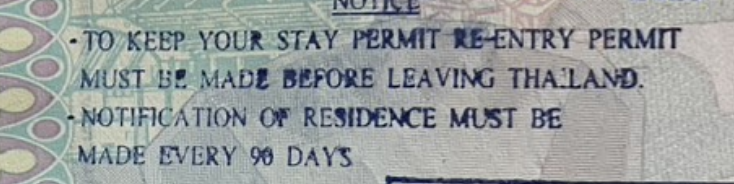
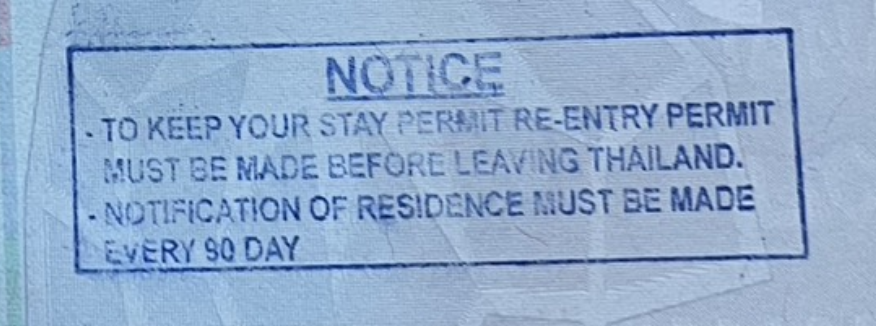
Part of the confusion is that the re-entry warning is often stamped right next to the 90-day reporting reminder. Some people wrongly assume the two issues are similar, or that if they forget the re-entry permit they can just pay a fine later. That is not the case. Missing a 90-day report may lead to a penalty, but leaving Thailand without the required re-entry permit can wipe out the entire permission to stay you had before.
That means even if you received a one-year permission to stay and then left Thailand the very next day without a re-entry permit, you could lose that whole year. In many cases officers will not stop you on the way out and will not warn you that your stay is being lost. They may simply let you depart, and the problem only becomes obvious when you try to come back.
This is exactly why the immigration warning stamp matters so much. It is easy to read past it, especially when it appears beside the 90-day reminder, but the consequence is much more serious. If your stay needs protection, make sure you arrange either a single re-entry permit or a multiple re-entry permit before you leave Thailand.
Where you can apply
A re-entry permit can often be applied for at the airport on the date of departure. This is useful for last-minute cases, but it should be treated as a backup option rather than your preferred plan if your travel is important.
- Prepare your passport, a completed TM.8 form, a passport photo if required, and enough time before check-in.
- Go to the airport immigration or passport control area that handles re-entry permits on the date of departure.
- Pay the official immigration fee, receive the re-entry stamp, and only then proceed with your departure process.
- Do not leave this until the final minute, because airport counters can be busy and operating arrangements can vary.
You can also apply ahead of time at immigration before your trip. For many people, this is the better route because it removes last-minute airport pressure and gives you time to fix any document issue before departure day. If you already know you will travel several times, you can apply for a multiple re-entry permit instead of repeating single permits again and again.
Best practice
If your trip matters, arrange the re-entry permit in advance. Airport filing is possible most of the time, but advance filing is calmer, safer, and easier to correct if anything is missing.
The airport option is real, but do not be casual about it
Many people hear "you can do it at the airport" and then mentally downgrade the issue into something simple they will sort out later. That is exactly the mindset that creates problems. Airport counters may exist, but queues, document gaps, timing pressure, airline deadlines, and travel stress all reduce your margin for error.
The better mindset is this: if you absolutely must use the airport option, arrive with documents prepared and enough time to solve a problem. If you can apply in advance, do that instead.
Common mistakes that cause unnecessary problems
- Thinking a visa extension automatically means unlimited travel in and out of Thailand.
- Assuming a previous multiple-entry visa status still applies after switching to an in-country extension of stay.
- Reading the word "visa" in everyday conversation and forgetting that immigration may actually be dealing with an extension of stay.
- Leaving the re-entry permit until the final moments before departure.
- Believing that one single re-entry permit will cover multiple future trips.
- Confusing a multiple-entry visa with a multiple re-entry permit even though they are different immigration tools.
- Relying on memory instead of checking the current passport stamp and the current basis of stay.
Simple rule if you are unsure
If your visa is not obviously a multiple-entry visa that still remains valid in that form, assume you need a re-entry permit and verify before traveling.
Why we made this page so detailed
Normally this topic gets explained in a few sentences, but that is often not enough. People travel while tired, rushed, stressed, or focused on flights, family, work, emergencies, and checklists. Even when they have already been told, they may still think "it will probably be fine" or "I can sort it out later."
This page is intentionally long because the cost of misunderstanding can be much higher than the cost of reading carefully for five extra minutes. If this page prevents even one person from accidentally cancelling a retirement, marriage, work, or other long-stay arrangement, then it has done its job.
Frequently asked questions
Do I need a re-entry permit if my visa already says multiple entry?
Usually no, as long as your current visa genuinely includes multiple entry and you are still traveling on that visa validity. The risk begins when people are no longer relying on that original multiple-entry structure and are instead living on an extension of stay inside Thailand.
Can I get the permit at the airport?
Most of the time, yes, it can be applied for at the airport on departure day. But because travel pressure can create mistakes, advance filing at immigration is usually the safer option.
Can I apply for a multiple re-entry permit instead of buying single permits every time?
Yes. If your current stay is the type that needs re-entry protection and you expect multiple trips, the multiple re-entry permit allows unlimited re-entries for the remaining life of that stay.
Does a re-entry permit extend my stay?
No. It only protects the stay you already have. It does not add extra days or create a new permission to stay.
Is residence reporting the same as a re-entry permit?
No. They are separate obligations. The immigration notice itself often mentions both items together, but they are not remotely the same consequence. A re-entry permit does not replace 90-day reporting, and 90-day reporting does not replace a re-entry permit. Missing a 90-day report may lead to a fine. Leaving Thailand without the required re-entry permit can cause you to lose your existing permission to stay entirely.
Final reminder before you travel
If your current stay is not clearly covered by a built-in multiple-entry visa, do not assume you can leave and return without applying first.
If you only need one trip, a single re-entry permit may be enough. If you expect to travel more than once, a multiple re-entry permit is often the smarter choice.
Airport filing is usually possible, but advance filing is safer. When in doubt, arrange it before departure day.
If you want us to arrange it, our prices are at the top of this page. We only add ฿200 on top of the official immigration fee.